
Claim Settlement Ratio vs Incurred Claim Ratio
Claim Settlement Ratio vs Incurred Claim Ratio
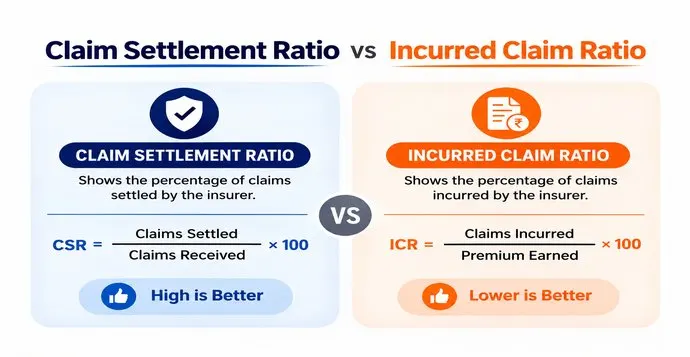
Claim Settlement Ratio (CSR) tells you how many claims an insurer settles compared with the claims it receives, while Incurred Claim Ratio (ICR) tells you how much the insurer pays in claims compared with the premium it earns.
Neither metric should be used alone when choosing health insurance. CSR helps you understand claim-settlement performance, while ICR provides insight into the insurer's claims experience relative to its premium income. You should also consider coverage, exclusions, waiting periods, claim procedures, network hospitals, co-payment and other policy terms.
Claim Settlement Ratio vs Incurred Claim Ratio: What's the Difference?
Buying health insurance often starts with a simple question: Which insurance company should I choose?
Then you start comparing plans and come across terms such as Claim Settlement Ratio (CSR) and Incurred Claim Ratio (ICR). At first, both may sound like complicated insurance jargon. But they answer two very different questions. If you're comparing health insurance companies, understanding these two numbers can help you look beyond advertisements, rankings and premium prices.
Let's make it simple.
What Is Claim Settlement Ratio?
Claim Settlement Ratio is the percentage of claims an insurer has settled compared with the total claims it received during a particular period. For example, suppose an insurer receives 1,000 claims in a year and settles 950 claims.
Its Claim Settlement Ratio would be: 950 ÷ 1,000 × 100 = 95%
So, the insurer's CSR would be 95% for that period.
In simple words, CSR answers:
Out of the claims received, how many were settled?
However, it's important to understand that a high CSR does not mean every claim will automatically be approved. Individual claims are assessed according to the policy terms, coverage, exclusions, waiting periods, documentation and other applicable conditions.
What Is Incurred Claim Ratio?
Incurred Claim Ratio (ICR) compares the claims incurred by an insurer with the premium it earns during a particular period. In simple terms, it helps show how much of the premium income is being used toward claims. For example, if an insurer earns ₹100 crore in premium and incurs ₹70 crore in claims, its ICR would be approximately:
₹70 crore ÷ ₹100 crore × 100 = 70%
So, the ICR would be 70%. ICR answers a different question:
How much has the insurer incurred in claims compared with the premium it earned?
This makes ICR useful for understanding an insurer's overall claims experience, but it should not be interpreted as a direct measure of whether your individual claim will be approved.
What Is the Difference Between CSR and ICR?
The easiest way to understand the difference is to remember:
CSR focuses on claims.
ICR focuses on claims compared with premiums.
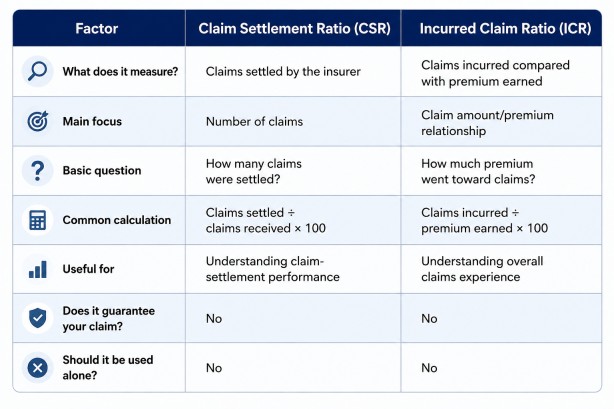
The two ratios complement each other rather than replacing one another.
Why Is Claim Settlement Ratio Important in Health Insurance?
When buying a policy, you want to know how an insurer handles claims.
That's where Claim Settlement Ratio becomes useful.
A consistently strong CSR can be one factor to consider while comparing insurers because it provides information about the proportion of claims settled during a particular period.
But there is an important catch. CSR doesn't tell you everything.
It doesn't tell you:
- Whether a particular treatment is covered
- Whether a waiting period applies
- Whether an exclusion applies
- Whether your preferred hospital is in the network
- How much of a particular claim was paid
- Whether a policy has room-rent restrictions
- Whether co-payment applies
That's why you shouldn't choose a health insurance policy simply because one company has a higher CSR.
Why Is ICR Important?
ICR gives you a different perspective.
Suppose two insurers have similar Claim Settlement Ratios. Looking at their ICR can provide additional context about their claims experience relative to their premium income. A very low ICR may indicate that claims incurred are relatively low compared with premiums earned, while a very high ICR may indicate that claims incurred are relatively high compared with premium income.
But higher is not automatically better, and lower is not automatically better.
ICR needs context.
The ratio can be influenced by factors such as the insurer's business mix, pricing, claims experience, expenses and other financial factors.
Therefore, it is better to use ICR as one part of your overall comparison, rather than treating a particular percentage as a universal benchmark.
Which Is More Important When Buying Health Insurance?
Neither CSR nor ICR should be considered more important on its own. They measure different things.
If you're evaluating an insurer, CSR can help you understand its claim-settlement record, while ICR can provide insight into claims incurred relative to premium income.
But your final decision should also consider:
Coverage → Sum Insured → Waiting Period → Exclusions → Network Hospitals → Co-payment → Sub-limits → Claim Process → Premium → Renewal Terms
This is particularly important when comparing a Health Insurance Claim Settlement Ratio across different insurers.
A company with a high CSR may still offer a policy that doesn't suit your requirements.
Similarly, an insurer's ICR alone cannot tell you whether its policy is right for you.
Is a Higher Claim Settlement Ratio Always Better?
Not necessarily.
A high Claim Settlement Ratio can be a positive indicator, but it should be interpreted carefully.
For example, imagine two insurers:
Insurer A: CSR – 98%
Insurer B: CSR – 95%
It may be tempting to immediately choose Insurer A. But what if Insurer A's policy has:
- Higher premium
- Longer waiting periods
- More exclusions
- Lower coverage for certain treatments
- Restrictive sub-limits
While Insurer B offers coverage that better matches your requirements?
The percentage alone doesn't answer which policy is better for you.
The better approach is to use CSR as one comparison factor, not the entire decision.
Does a High ICR Mean an Insurer Is Better?
No. A high ICR does not automatically mean an insurer is better.
ICR shows the relationship between claims incurred and premium earned. A higher ratio can mean a larger proportion of premium income is associated with claims, but that doesn't automatically translate into better customer experience or better policy coverage.
Likewise, a lower ICR doesn't automatically mean an insurer is poor. You need to understand the context behind the number.
Think of ICR as a financial indicator, not a scorecard that ranks insurers from best to worst.
CSR vs ICR: Which One Should You Check First?
If you're a consumer comparing health insurance, CSR may be easier to understand because it directly relates to claims settled.
However, you shouldn't stop there.
A sensible evaluation could look like this:
Step 1: Check the insurer's Claim Settlement Ratio.
Step 2: Understand its ICR and what the figure represents.
Step 3: Compare the actual policy coverage.
Step 4: Check waiting periods and exclusions.
Step 5: Check network hospitals.
Step 6: Look at co-payment, deductibles and sub-limits.
Step 7: Compare premiums and renewal terms.
Step 8: Read the policy wording and Customer Information Sheet.
This gives you a much more complete picture.
How Should You Compare Health Insurance Companies?
Instead of searching only for:
Which health insurance company has the highest Claim Settlement Ratio?
Try asking:
Which insurer offers suitable coverage and has a satisfactory claim record for my requirements?
That's a much better question.
When comparing healthcare companies, consider both quantitative and policy-related factors.
Check the Claim Settlement Ratio: Understand how many claims were settled during the relevant period.
Check the Incurred Claim Ratio: Use ICR to understand the insurer's claims incurred relative to its premium income.
Examine the Policy: Look beyond company-level statistics and read the actual plan's terms.
Check the Waiting Period: Pay attention to initial, specific-disease and pre-existing disease waiting periods.
Check Exclusions: Knowing what isn't covered can be just as important as knowing what is covered.
Check Network Hospitals: Make sure your preferred hospitals are available for eligible cashless treatment, subject to the insurer's current network and applicable conditions.
What Is a Good Claim Settlement Ratio?
There isn't a single percentage that automatically makes an insurer the best.
A higher CSR can be useful as a comparison indicator, but the number should be considered alongside the insurer's claims data, policy conditions and other relevant factors.
Also remember that CSR figures can vary by reporting period and methodology. When comparing insurers, always check that you're comparing figures for the same period and the same type of metric.
This is particularly important when researching the latest Health Insurance Claim Settlement Ratio.
Common Mistakes When Comparing CSR and ICR
Many buyers make the same mistakes when looking at insurance ratios.
Mistake 1: Looking only at CSR: A high CSR doesn't automatically mean the policy has comprehensive coverage.
Mistake 2: Assuming a high ICR is always better: ICR requires context. Higher isn't automatically better.
Mistake 3: Comparing different periods: Always check the financial year or reporting period behind the numbers.
Mistake 4: Ignoring the policy wording: Company statistics cannot replace reading the actual policy conditions.
Mistake 5: Choosing based only on rankings: Rankings can help create a shortlist, but your healthcare needs should drive the final decision.
So, What Should You Remember About CSR vs ICR?
Here's the easiest way to remember it:
- CSR tells you about the proportion of claims settled.
- ICR tells you about claims incurred relative to premium earned.
They are different metrics designed to answer different questions. If you're researching Claim Settlement Ratio before buying health insurance, don't stop at one percentage. Use CSR and ICR together with coverage, exclusions, waiting periods, network hospitals, premium and other policy conditions.
At Policy Hub, we believe the purpose of comparing insurance isn't to find the most impressive number. It's to understand what that number means and whether the policy actually fits your needs.

5.0
Need advice from experts?
Health is tricky, and insurance trickier. But we’ll simplify it for you — for FREE! Book a call now. Limited slots available!
 Talk to an Advisor


 Talk to an Advisor